What Is the Most Expensive Thing on Amazon? (2026)

The honest answer is that the most expensive thing on Amazon depends on the day you look. As of early 2026, lists have pointed to fine art carrying eight figure price tags, with one painting reported around 32 million dollars, while others crown a rare coin near 288,000 dollars or a diamond necklace in the tens of millions. The top spot moves, and the sources flat out disagree.
Stick around and you get the real examples, why these things cost what they do, and how to find and check the current answer yourself.
The first thing you notice when you sort Amazon by the highest price is that the results do not look like normal shopping anymore. You may see fine art, rare collectibles, luxury jewelry, industrial equipment, unique books or high-ticket décor with prices that feel closer to an auction house than an everyday marketplace. That is why the answer changes so often. The most expensive thing on Amazon is not a fixed product. It depends on what is live, available, and priced highest on the day you check.

Why there is no single permanent answer
This is the part most lists skip, and it is the most important thing on the page.
Amazon does not publish its biggest sales. So any claim about the “most expensive item ever sold” is mostly guesswork dressed up as fact. Nobody outside Amazon has the receipt.
The listings themselves come and go. Third party sellers add a one of a kind piece, then pull it down when it sells or when authentication falls through. What sat at the top last week may be gone today.
And the sources do not agree with each other at all. In the same stretch of early 2026, you can find one blog naming a 288,000 dollar coin as the winner, another pointing to a 32 million dollar painting, and a third claiming a 55 million dollar necklace. That spread, from six figures to eight, is not a small rounding gap. It tells you how shaky every one of these claims really is.
Then there are the listings that just look off. A huge number, one blurry photo, a thin description, and no real documentation. That combination should make you doubt whether the listing is serious at all, or whether anyone has ever paid the price on it.
One sign that makes me skeptical is when a listing has a huge price but very little proof behind it. For example, if an item is priced like a museum piece but the photos are blurry, the description is thin, the seller has limited history, and there is no certificate, provenance, grading report, or authentication detail, I would not treat it as a real “most expensive” contender. A high price alone does not prove value. For rare art, coins, jewelry, and collectibles, the proof matters as much as the number.

The priciest listings people actually find
So with all that said, here is the kind of thing that shows up near the top. Treat these as dated examples, not gospel.
Fine art usually sits at the very top. Original paintings have been listed in the eight figure range, and as of early 2026 a painting titled by a single artist was reported at around 32 million dollars, though the listing had almost no supporting detail, which is its own red flag.
Rare graded coins are the next tier. A high grade Morgan dollar, the kind preserved in near perfect condition, has been listed around 288,000 dollars. The grade is the whole story there, and I will get to why in a minute.
Luxury jewelry with certified diamonds climbs into the millions. Certified is the key word. A stone with paperwork behind it is a different animal from one without.
Collectibles round it out. Graded sports memorabilia and rare stamps regularly command six figures, like a game worn signed jersey reported north of 600,000 dollars.
And then the oddballs. Tiny homes, industrial machines, and oversized gear show up too, often flaunting “free shipping.” Do not fall for that line. On freight sized items, free shipping usually means delivery to a freight terminal only. You still pay a rigger or a crane operator to get the thing off the truck and onto your property. Read that fine print before you get excited.
When you check high-priced Amazon listings yourself, the pattern is usually more useful than the exact winner. One listing may show a rare coin with a very high asking price, while another may show fine art, luxury jewelry, or a collectible priced far above normal retail. But the price tag alone is not enough. Before treating any listing as serious, check the seller history, photos, description, certification, grading, provenance, and whether the item looks properly documented. For this topic, a dated screenshot is better than a copied list, because the top listings can change quickly.

Why these items cost so much
The big numbers are not random. A few things drive almost all of it.
Rarity comes first. One of a kind art, low population graded coins, discontinued pieces. When there is only one, or only a handful, scarcity does the heavy lifting on price.
Certification and grading matter just as much. A coin graded MS-65, or a diamond with a GIA report, is worth far more than the same item ungraded. The reason is simple. The grade is verified by a neutral third party, so the buyer is not just trusting the seller’s word. That verification is what the premium is really buying.
Material and craftsmanship add real cost on top. Platinum settings, large carat diamonds, work done by hand. None of that is cheap to make, so none of it is cheap to buy.
And collector demand can multiply everything. Provenance, a famous previous owner, a signature, a story. Attach a name people care about and the price stops following any normal logic.
A rare graded coin is a good example. The metal value alone does not explain the price. What makes it expensive is the combination of rarity, condition, certification, and collector demand. If only a small number of that coin exist in a high grade, and it comes with trusted third-party grading, buyers are not just paying for the coin. They are paying for proof, scarcity, and confidence that the item is exactly what the seller claims it is.

How to find the most expensive items yourself
You do not need a guide to do this. You need about five minutes.
Start by searching a broad category. Then sort the results by Price: High to Low. That alone surfaces the eye watering stuff. A few category pages worth a look: Fine Art Paintings, 10,000 dollars and above, Collectible Coins, and the Fine Jewelry and Collectibles departments.
Aim at categories where the big numbers live. Fine Art, Collectible Coins, Fine Jewelry, and Collectibles are where you will find them. Everyday categories top out fast by comparison.
Watch out for the placeholder and joke listings. Some sellers park an absurd number on a thin listing, and it floats right to the top of your sort, skewing what you see. Those are not the real story, so do not stop there.
Bookmark a few of the serious ones and check back in a week. The order will have shifted, which is the whole point of this topic.
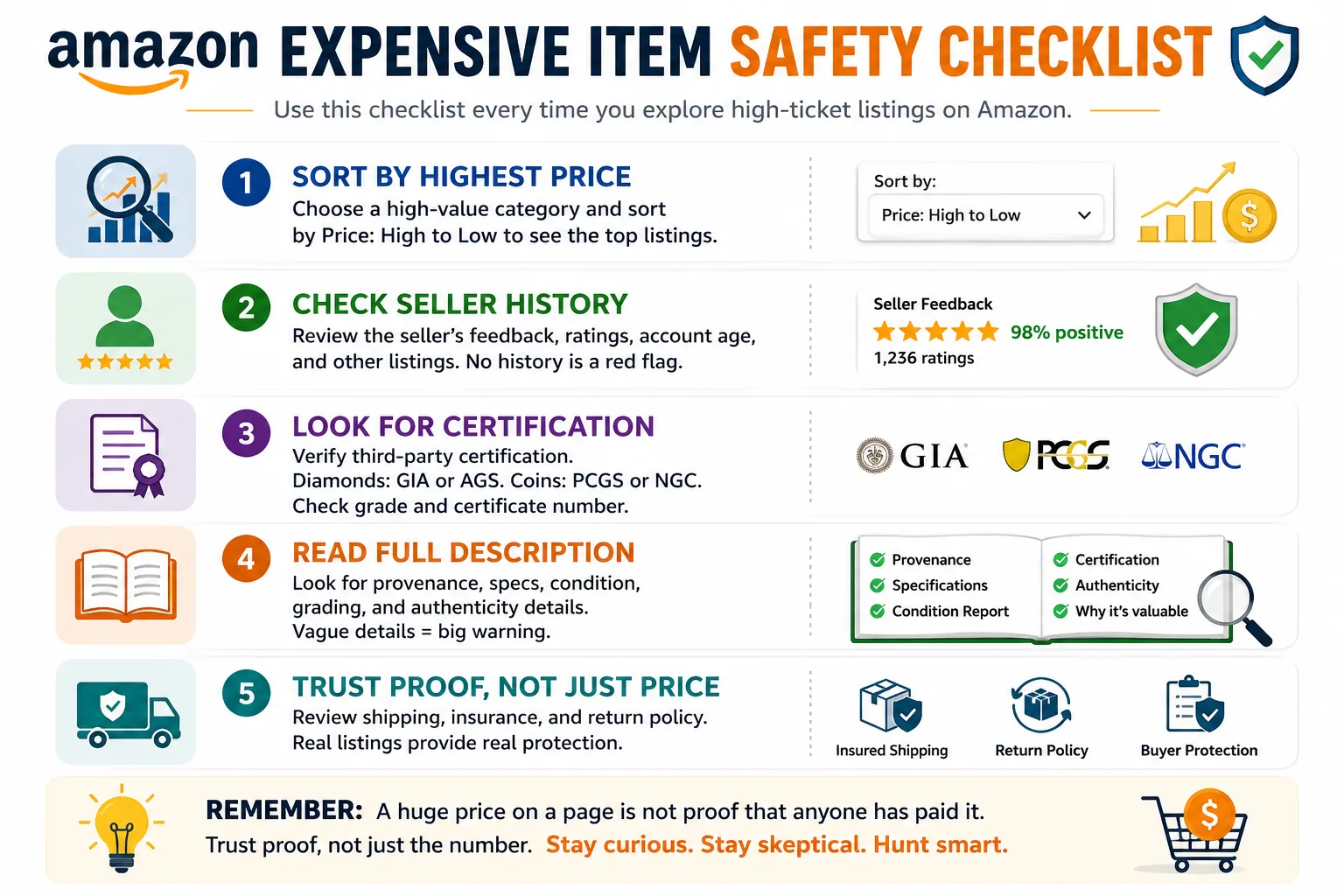
Here is the safest way I would check it myself. I would start with a broad category like Fine Art, Collectible Coins, Fine Jewelry, or Collectibles, then sort the results by price from high to low. The first few results may look impressive, but I would not trust the number immediately. I would open the listing, check the seller, review the photos, read the description, and look for proof such as grading, certification, provenance, or authentication. If the listing has a huge price but weak details, I would treat it as questionable, not as the real answer.

How to tell a real high ticket listing from a questionable one
This is the part worth slowing down for, because a high number on a page is the easiest thing in the world to type.
Look for third party certification first. For diamonds that means GIA or AGS. For coins it means PCGS or NGC. If a luxury listing names the grading body and the specific grade, that is a good sign. If it does not, treat the price as a number someone made up.
Check the seller, not just the item. Look at their history, their other listings, their feedback. A serious six or seven figure piece sold by an account with no track record deserves real suspicion.
Read the entire description. Genuine high ticket listings document provenance, specs, and certification in detail because the seller knows that is what justifies the price. A giant number sitting above one photo and two lines of text is a flag, not a deal.
Read the shipping and return terms too, especially on freight. That “free shipping” line hides a lot, and the return policy on a one of a kind item is not the same as on a phone case.
Hold onto the core idea. A price on a product page is not proof that anyone has ever paid it. The listing existing and the sale happening are two completely different things.
Before I believe any luxury or high-ticket Amazon listing, I check five things. First, does the listing show real certification, such as GIA or AGS for diamonds, or PCGS/NGC for coins? Second, does the seller have a serious history and strong feedback? Third, are the photos clear and detailed, not just one blurry image? Fourth, does the description explain provenance, grading, specs, condition, and authenticity? Fifth, are the shipping and return terms realistic for a high-value item? If the price is huge but the proof is weak, I treat it as a questionable listing, not a real market value.

What sellers can take from this
If you sell on Amazon, there is one quiet lesson in all of this. The listings that justify their prices are the ones loaded with documentation, certification, and clear specs. Trust is what lets a number climb. Detailed listings, real proof, and specifics are not just for million dollar art. They are how any seller earns the right to charge more.
FAQ
What is the most expensive thing on Amazon right now? It changes, so any answer comes with a date. As of early 2026, reported contenders ranged from a roughly 288,000 dollar graded Morgan dollar to paintings listed in the tens of millions. The only honest answer is to sort the category by price yourself on the day you are asking.
What is the most expensive item ever sold on Amazon? Nobody outside Amazon actually knows. Amazon does not disclose its highest value transactions, so every figure you see floating around is unconfirmed. People quote numbers up to tens of millions, but those are listing prices or guesses, not verified sales records.
Can you actually buy these items? Often, yes, the genuine ones with real documentation are purchasable like anything else. But a chunk of the ultra high listings look questionable, with thin detail and a single photo, and some appear to function more as advertisements than real buy it now offers.
Why are some Amazon items so expensive? Four things, mostly. Rarity, third party certification or grading, premium materials and craftsmanship, and collector demand. A verified grade or a famous provenance can multiply a price far beyond what the raw materials would suggest, which is why coins and art top these lists.
Is shipping really free on huge expensive items? Usually not in the way it sounds. On freight sized items, free shipping typically covers delivery to a freight terminal only. From there you pay for a rigger or crane to get it to your property. Always read the freight fine print before assuming free means free.
The fun is in the hunt
Whatever number you find today will probably be wrong by next month, and that is fine. On a topic like this, the exact figure matters less than knowing how to find it and how to judge whether it is real.
So go sort a category by price, scroll to the top, and then do the part most people skip. Ask whether the listing in front of you is an actual item with proof behind it, or just a big number someone typed and walked away from.
The strangest thing about these high-priced Amazon listings is how quickly the number stops being the interesting part. You may see a rare coin, a luxury necklace, a piece of fine art, or a collectible with a price that looks unbelievable, but the real question is always the same: what proof supports it? The most memorable listings are not just the ones with the biggest price tags. They are the ones where the seller shows clear photos, real certification, strong history, and enough detail to make the price feel possible instead of random.